
Lanificio Digitale in the spaces of Santa Caterina a Formiello
Our Open Innovation Hub is born in the spaces of the Ex Lanificio Borbonico, once a convent, an example of industrial archaeology in the Kingdom of the Two Sicilies.
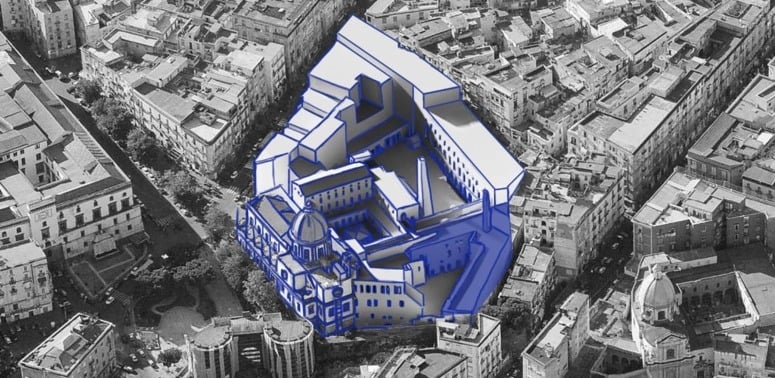
For its Open Innovation Hub, Lanificio Digitale has chosen the spaces overlooking the cloister of Santa Caterina a Formiello, in Naples, which later became the Bourbon wool mill.
In the Porta Capuana area, which has been and still is a key hub for trade and travel, a coworking space of about 900 square meters will open, supporting coaching and team building activities.
The Open Innovation Hub aims to offer meetings and exchanges between professionals, digital talent, and market needs, bringing together digital opportunities and offline relationships.
"The name and logo of our project preserve the history of the place we have chosen to inhabit - explain the two co-founders Giordano Iovine and Davide Bussetti -, namely that of the former Lanificio Sava".
The area is probably better known for the cloister of Santa Caterina a Formiello than for the Lanificio Sava; it is a short walk from Garibaldi Station and the historic center of Naples, a UNESCO site, and it has a history well worth telling.
In recent years, new business and cultural organizations have settled in these spaces and are helping to redevelop the Ex Lanificio Borbonico, in an osmotic relationship with the city.
The church and convent of Santa Caterina a Formiello: the origins
The book "Il Lanificio Sava. Un esempio di architettura industriale nel Regno delle due Sicilie", written by Remo F.M. Malice (Kaleidon editrice), cites several sources to retrace the incredible history of these places, calling for them to be properly valued.
The first reliable records date back to around the second half of the 1400s, when the textile factory did not yet exist and the structure was used as a convent.
The church was called “a formiello” because it recalled the conduits, the channels, connected to the ancient Bolla aqueduct, which toward the end of the 19th century was replaced by the Sirino aqueduct, still in use today.
Originally the church and convent were a cenoby of hermit friars of the Celestine order and stood outside the Angevin city walls, to which they were annexed in 1484 thanks to Alfonso II of Aragon.
Toward the end of the 1400s, another important event involved Santa Caterina: the construction of Villa della Duchesca, near Castel Capuano, at the behest of the Duke of Calabria.
The villa was to have a large garden, fountains, baths, and a hippodrome. For this, it was necessary to include the large neighboring spaces occupied by the convent of the Augustinian nuns of Santa Maria della Maddalena, who put up considerable resistance.
With the payment of 2,000 ducats, the Celestines joined their fellow friars in the Neapolitan convent of San Pietro a Maiella, ceding the convent to the Augustinian nuns. Their stay lasted barely eight years. The nuns returned to their original home in 1498 thanks to King Federico, while the church and convent were offered by the sovereign to the Lombard Dominicans, who remained there without interruption until the early 1800s. It was they who began the work of modernizing the church and convent, completely changing their architecture.
The success of the Lanificio Sava
In the early 1800s, under the Kingdom of Naples, the Convent of Santa Caterina was among the suppressed monasteries and was granted to the Amalfi textile entrepreneur Raffaele Sava, who decided to convert the existing convent buildings into a textile industry, the Lanificio Sava.
Within a short time the wool mill, thanks in part to the numerous incentives granted by the Bourbon government, became the most important textile industry in the Kingdom of the Two Sicilies.
The industry stood out from the others for the quality and quantity of its products, but also for the number of its employees: it provided work for about 700 people, and even prison inmates were involved in making uniforms for the Neapolitan army.
The crisis and abandonment of the Bourbon wool mill
After the unification of Italy, the wool mill's period of decline began.
The State no longer granted the numerous forms of support that the Bourbon regime had guaranteed and that had allowed the industry to prosper during their reign; political prisoners were freed, depriving the industry of the cheap labor it had benefited from.
Like the other industrial businesses of that period, the Lanificio Sava therefore ran into economic difficulty, and it ceased its activity for good in 1870.
After the industry closed, the former convent and wool mill was abandoned and even risked being razed to the ground by the Società di Risanamento.
During the Fascist era some warehouses were torn down, while during World War II the population used the underground rooms as air-raid shelters; in fact, during this period some parts were destroyed by an air attack by Anglo-American troops.
Later, besides being used as private homes, many spaces were turned into small family-run craft workshops.
A new life for the spaces of Santa Caterina a Formiello
What remains? The entrance portal still bears the typically neoclassical stucco decoration, in which the outline and the relief inscription “LANIFICIO” are barely legible.
Once through the entrance, it is impossible to miss the two chimneys and the columns of the cloister, incorporated into the architectural layering that has taken place over the years.
Today, in the cloister of Santa Caterina a Formiello, the former Lanificio Sava, a redevelopment project has been launched thanks to several private initiatives.
Within the complex there are various organizations promoting cultural, business, educational, and social initiatives, such as puntozerovaleriaapicella, Luigi Solito Galleria Contemporanea, MudStudio, Officina Keller, Associazione Culturale Jimmie Durham, Cooperativa Sociale Dedalus, Lanificio25, and Made in Cloister, to name a few.
“We are happy to inhabit these spaces and to give them back to the city as a meeting point for ideas, technologies, professional skills, and market needs. Our business - the co-founders Giordano Iovine and Davide Bussetti enthusiastically confirm - and above all the approach of our Open Innovation Hub are deeply rooted in professional skills, in the local area, in its history, and in its enhancement.
The Lanificio Digitale icon is also inspired by the Jacquard loom and is meant to recall the punched cards that were the ancestors of computers”.