
Lanificio Digitale: new languages of contemporary art in an Open Innovation Hub
For three days, more than 100 young artists were involved, some for the first time in Italy, taking part in the creation of interactive experiences made possible by new technologies.
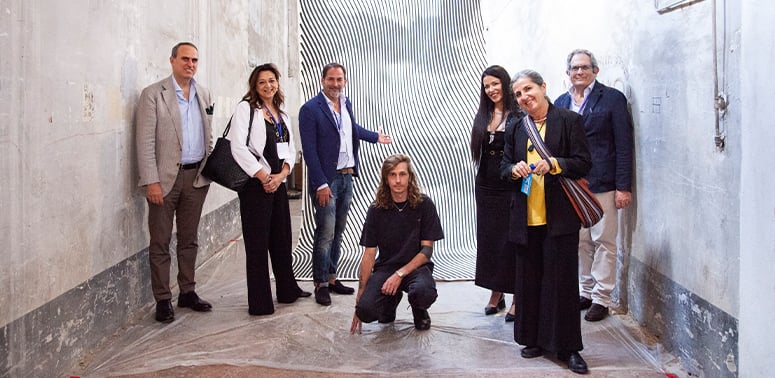
From May 10 to 12, New Fluxus, an international event on the new languages of contemporary art, took place in Naples at Lanificio Digitale, a space inside the former Lanificio Borbonico of Porta Capuana.
Created in collaboration with the artist collective NFTCC (NFT Community Conference), founded by the artist Luca Martinelli (aka Vandalo Ruins) and by the artistic director of Lanificio Digitale, Simona Zamparelli, the three-day event involved more than 100 young artists, some for the first time in Italy, with the creation of interactive experiences made possible by new technologies.
In the space designed by the architect Corrado Foglia, physical and digital works interacted, inviting reflection on political and social issues.
The spaces of the former Lanificio Borbonico were the perfect stage for a succession of meetings and talks with artists, gallery owners, and entrepreneurs, as well as events dedicated to performance art, AI Art, and Cryptoart with video projections and installations.
"There was great participation from the public and the curious at this first inaugural event of Lanificio Digitale's future cultural program, which will combine art and new technologies,” said an enthusiastic Simona Zamparelli, artistic director of Lanificio Digitale and curator of the event.
New Fluxus was also the occasion for the founding partners of Lanificio Digitale, Davide Bussetti and Giordano Iovine, to launch, during the institutional talk “Sguardo verso il Futuro: Innovazione per il Territorio,” the ambitious urban regeneration project for the creation of an Open Innovation & Cultural Hub, officially presenting it to institutions, start-uppers, innovators, potential investors, and experts from the academic and digital worlds.
Speakers included Laura Lieto, deputy mayor of the City of Naples, Valeria Fascione, Councilor for Research, Innovation and Startups of the Regione Campania, Giorgio Ventre, Director of the Apple Academy Developer, connected remotely, and also contributing in person Ivo Allegro, CEO of Iniziative Finanza e Innovazione, Ambrogio Prezioso, President of Est(ra)Moenia, and Franco Rendano, President of the Carlo Rendano Association - Lanificio 25.
The project is quite challenging and aims - through the renovation and redevelopment of a multifunctional space of more than 900 square meters, located inside the former Lanificio Borbonico (where other organizations promoting social and cultural initiatives are already present), at Porta Capuana, in the heart of the historic center of Naples, a cultural and new technology hub available to the city and a point of reference for the area.
The event, dedicated to digital art and new technologies, ended on Sunday, May 12, with a live performance at Made in Cloister, where the collective's artist Ivona Tau interacted through artificial intelligence with the physical works of the Interaction exhibition currently on view at the Cloister.
"Our Open Innovation Hub: an idea factory for the area and for the development of young talent"
“As an engineer in the TLC sector and an entrepreneur for over twenty years,” explains Davide Bussetti, CEO and Co-Founder of Lanificio Digitale together with Giordano Iovine, “we strongly believe in creating a hub that combines innovation and culture, an idea factory capable of involving the city and the entire area in a virtuous process of urban regeneration centered on developing our young talent”.
"Culture and Innovation have already proven to be an important pairing for triggering and sustaining successful urban regeneration processes. It is important,” concluded Ivo Allegro, CEO of Iniziative, Finanza e Innovazione, “that the concept of innovation is not limited to technology but also looks more broadly at innovations in method and approach.
In this sense, especially in a city like Naples, one of great enthusiasm but also of great and sudden falls, it is necessary to innovate intervention models by moving beyond a purely public logic and integrating public and private intervention in partnership logics, decisively focusing on Public-Private Partnership".