
NFTs, beyond crypto art
More than three hundred people, enthusiasts and newcomers alike, attended panels, conversations, and the historical-archaeological exhibition dedicated to NFTs and crypto art.
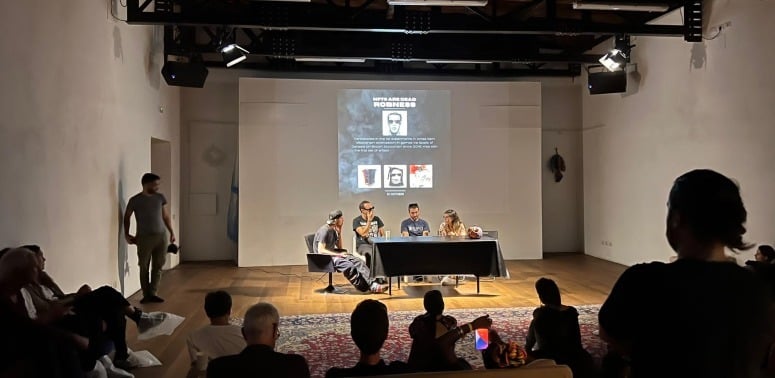
NFTs Are Dead: The Funeral. Over the Halloween long weekend, art lovers and the curious gathered in Naples for the two-day event dedicated to digital art.
Sewer Nation, the international under-30 collective, bet on the city without hesitation, together with Space Farm, Ultraviolet-to, Cryptoartitalia, Ninfa.io, and puntozerovaleriapicella, in collaboration with Lanificio Digitale.
More than three hundred people, enthusiasts and newcomers alike, attended the panels and conversations held on the mornings of October 31 and November 1 in the Ex Lanificio Borbonico on Piazza Enrico de Nicola - in the spaces of Lanificio Digitale and puntozerovaleriaapicella - before moving on to the Galleria Borbonica. There, around a hundred digital works, created with artificial intelligence, were projected along the underground viaduct commissioned in the mid-nineteenth century by Ferdinand of Bourbon.
Guiding experts and visitors through a truly unique immersive experience was a digital Dante, who retraced the cultural milestones of blockchain technology and NFTs (Non-fungible tokens).
NFTs: where are we heading?
“Our group was born in February,” says Luca Martinelli, known as Vandalo, creative director and founder of Sewer Nation. “We created a DAO (Decentralized Autonomous Organization), designing cultural events to promote decentralized technology such as blockchain and NFTs.
Over the last four years, Italy has proven to be an incredible powerhouse in crypto art, with many curators and artists.
I noticed a gap between the history and the direction we were heading in, so I thought of organizing a historical-archaeological exhibition to look together at the first pieces from 2015 and the early points of view, and to understand how this path has evolved.
We have already organized events in Rome and Milan, which is overcrowded with activities. In Naples we wanted to offer a new concept, crypto art with a historical perspective, and we are happy to have gathered the enthusiasm and participation of so many people in this adventure. We want to offer more inspiration and understanding of this technology, which has mysterious origins.”
It is in fact described as a genuine form of social art, which makes it possible to apply digital certification beyond the art world.
Why buy a digital work? The value of NFTs
“When we talk about digital works set on the blockchain, we are talking about certification of ownership.
The blockchain is a transparent database that cannot be compromised and guarantees forever the ability to certify a work of art, whether digital or physical. In my view, it goes even beyond these concepts.
CryptoPunks introduced the concept of digital identity.
Buying a CryptoPunk does not mean buying a digital work, but becoming the work of art. This is a truly interesting concept if we think about the world we live in. Since German post-existentialism, we have witnessed the continuous desacralization of the icons that once gave us a sense of belonging.
At a time when religion, the state, education, and work fail to build our identity, NFTs lend themselves, like all art that can be bought and put in our wallets, to telling the world and ourselves who we think we are. Buying crypto art means this too!
There is a great deal of speculation around this art form; on the other hand, there has always been a bad relationship between the market and art itself, just think of tax evasion.
Crypto art is not exempt from this, but it is also fair to say that there are groups on the blockchain, such as PowerDada, present at this event, that are looking for new ways to create radical divisions between the market and art, to make art more of a social tool than an economic one.”
The decentralization of Web 3.0
“We are aware that the internet is free - Martinelli concludes - but we know that when something is free, we are the product.
A centralized database, like those of Bitcoin and Ethereum, makes it possible to have data inside ecosystems verified by many participants, not just by a central entity that manages it and perhaps sells it for profit.
Over the millennia, art has always been on the front line of cultural change, so it is no surprise that artists and NFTs are developing a symbiotic relationship, and it certainly does not end here.“
"The watchword is decentralize - Davide Bussetti, co-founder of Lanificio Digitale, echoed during one of the panels - the distribution of roles and of organizational capabilities.
A new philosophy in which blockchain and NFTs are only the tip of the iceberg; they can be applied to every business, to art as well as to fashion, food and beverage, with no exceptions! In short, it is a space that can offer many new opportunities and possibilities, but at the same time it demands a great deal of responsibility and initiative.”